Showing posts with label Sports Car. Show all posts

Tuesday, September 28, 2010

Mercedes Supercar C.S.V Concept With BCI System

The Mercedes Benz Cyborg Sensation Vehicle, or C.S.V., is a concept car imagined by Chinese designer Derek Chik Kin Ng. The C.S.V. is an off-road capable, two-seater supercar, Inspired by the Mercedes F400 concept, designed back in 2001, is targeted to young adventurous professionals in 2040.
Mercedes Supercar C.S.V Concept
Its pretty obvious, (thanks Captain Oblivious) what the core concept of this vehicle is just by name. Technology and organics are bound to merge sooner or later. Imagine driving just by thinking. When you sit in the drivers seat, your though patterns are sent to the vehicle, thus becoming an extension of your body. Theres no need for analog controls.
Mercedes Supercar C.S.V Concept
Mercedes F400 concept has served as the inspiration when creating this concept car of the future. It foreshadows a fully integrated driver interface, providing “driving…by thinking”.
Mercedes Supercar C.S.V Concept
The interesting part about this Mercedes Benz concept is that it has no steering wheel, no pedals, but this vehicle can be controlled with the power of mind instead. It uses a system named Brain Computer Interface (BCI), which creates a connection between the car and its driver, through a specially-designed helmet.
Mercedes Supercar C.S.V Concept
This way, the driver’s brain impulses are gathered by the helmet and transferred to the car, which responds appropriately. Although this principle may sound plausible in the future, its implementation on cars, could prove to be quite a difficult task.
Mercedes Supercar C.S.V Concept
The implications for such technologies means someday well know how to interpret, map out, and respond to human neural patterns. If you can put that thought aside for a second, lets focus on the design.
Mercedes Supercar C.S.V Concept
Theres a lot of F400 in there but the designer wanted to give the vehicle an organic flavor, hence the muscle fibers flanking each side, neatly tucking into a hidden skeletal system. The result is a design that takes Mercedes Benz DNA and evolves it into an organic object mimicking its pilot.
Mercedes Supercar C.S.V Concept

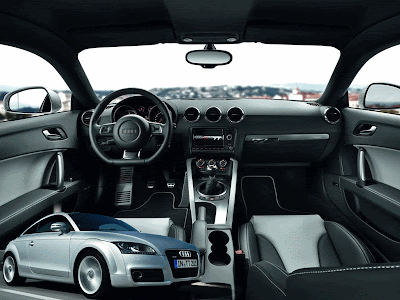
2011 Audi Sports Car TT Coupe Roadster

Dynamic design, enthralling performance and exemplary efficiency - the Audi TT Coupe and the TT Roadster are now more attractive than ever. The design of the lightweight bodies made primarily of aluminum and the interior have been revised with great attention to detail, while new technologies lower the fuel consumption of the compact sports car. New to the lineup is a powerful and highly efficient four cylinder: The 2.0 TFSI develops 155 kW (211 hp), but is content with an average fuel consumption of just 6.6 liters per 100 kilometers (35.64 US mpg).
2011 Audi TT Coupe and Roadster
The Audi TT Coupe and Roadster models enter the 2011 model year with some modest exterior styling changes, a revised interior and the introduction of the firm's new 2.0-liter TFSI gasoline engine with 211 ponies on the entry-level versions. The new 2.0 TFSI delivers 211HP and 258 lb-ft, or 11-horsepower and 51 lb-ft of torque more than its 2.0-liter predecessor. With the six-speed manual, the two-liter engine accelerates the Coupe from zero to 100 km/h (62mph) in 6.1 seconds on its way to a top speed of 245 km/h or 152mph.
The upgrades to the Audi TT Coupe and the TT Roadster have added two centimeters (0.79 in) to both cars, which now measure 4,187 millimeters (13.74 ft) in length. The width of 1,842 millimeters (6.04 ft) and the height of 1,352 millimeters (4.44 ft) and 1,357 millimeters (4.45 ft) for the Coupe and Roadster, respectively, remain unchanged. The wheelbase measures 2,468 millimeters (8.10 ft). Four new metallic colors have been added to the TT color range: Scuba Blue, Oolong Gray, Volcano Red and Dakota Gray. Daytona Gray, pearl effect is also available with the S line package.
The Audi TT 1.8 TFSI weighs a mere 1,240 kg (2,733.73 lb), a good 100 kilograms (220.46 lbs) less than its closest competitor. The body of the Coupés weighs only 206 kilograms (454.15 lb), which breaks down to 140 kilograms (308.65 lb) of aluminum (68 percent) and 66 kilograms (145.51 lb) of steel (32 percent). The specific reinforcements in the TT Roadster - steel bulkhead, strongly ribbed sills, A-pillar and windshield frame - result in a 58 to 42 percent split of the two materials.
The designers have added additional gloss to the fine interior. New aluminum-look applications shine on the steering wheel, the center console and in the door liner. Elegant accents are provided by rings, frames and strips in high-gloss black. The aluminum strip above the glove box door is now brushed gray. There are three new interior colors from which to choose - nougat brown, titanium gray and garnet red. The leather seat covers are specially treated to reduce thermal heating by as much as 20 degrees Celsius (68° F) when the Audi TT is parked in the sun.
The Audi TT Coupe and the TT Roadster are sports cars with a high degree of everyday utility. The backs of both rear seats fold down in the 2+2-seater Coupé, expanding the trunk space beneath the long lid from 292 to 700 liters (10.31 - 24.72 cubic ft). The Roadster, which offers 250 liters (8.83 cubic ft) of storage space whether the top is up or down, can also be supplied with the option of a load-through facility.
The S line sport package features a black interior with many fine details in such places as the steering wheel, the seat covers and the applications. 18-inch wheels and body lowered by 10 millimeters (0.39 in) make the handling even more dynamic.
The updated Audi TT Coupe and the TT Roadster will debut on the German market in the summer of 2010 with only minimal changes in price. The 1.8 TFSI will be available from €30,200.

Sunday, August 29, 2010

2012 Morgan Sports Cars EvaGT

Morgan was one of the first car companies to see the advantage of a bonded aluminium chassis to give rigidity but also to save weight. The 2012 Morgan Sport Car EvaGT uses a further developed version of the bonded aluminium chassis of the Morgan Aero SuperSports, a chassis that successfully competes in International GT3 Sports Car Racing. Compliant with European and US safety approvals.2012

2012 Morgan Sports Cars EvaGT

Morgan was one of the first car companies to see the advantage of a bonded aluminium chassis to give rigidity but also to save weight. The 2012 Morgan Sport Car EvaGT uses a further developed version of the bonded aluminium chassis of the Morgan Aero SuperSports, a chassis that successfully competes in International GT3 Sports Car Racing. Compliant with European and US safety approvals.2012

Thursday, August 26, 2010

2011 Perana Sports Car Z-One

South Africa is quickly becoming a hotbed for sports car development, with two new performance machines being announced in the country in just as many weeks. Built through collaboration between Zagato, the Milanese coachbuilders, and Perana Performance Group, the Z-One features a tubular and box section chassis with room for two passengers. Tucked among the exotica at Concorso Italiano  was the

Monday, August 23, 2010

Pre-war Car Petr Novague ECO Car Concept Inspired by F1 Technology

The concept vehicle is christened as ECO and features tube car frame, half-hood body and carbon components that add minimum possible weight to this energy efficient and eco friendly vehicle. Created by Petr Novague as a mark of respect for Laurin and Klement, a pre-war Czech company, Further, chromium-molybdenum steel made lattice truss frame in the front part of the car is attached to the carbon

2010 Volkswagen Sports Cars - VW Solar Powered Supercar Concept

It is a luxury supercar, it will only be built in a limited number of 200 units. It was designed to be able to cruise around in the year 2020. Volkswagen supercar presented at the 2010 Swansea Metropolitan University Degree Show in automotive design by Peter Wilkins not only promises to run by solar power with greater efficiency but also offers a competitive design styling.2010 Volkswagen Sports

Sunday, August 22, 2010

2011 Jaguar Sports Cars XKR 175

 Jaguar celebrates its 75th anniversary with the debut of the limited edition 2011 Jaguar XKR 175 Coupe at the McCalls Motorworks Revival at the Monterey Jet Center during the Pebble Beach Automotive Weekend. This is the first appearance of the exclusive sports car in North America.2011 Jaguar Sports Cars XKR 175The Jaguar XKR 175 is powered by a supercharged V8 with 510hp and 461 lb-ft of

2011 Jaguar Sports Cars XKR 175

 Jaguar celebrates its 75th anniversary with the debut of the limited edition 2011 Jaguar XKR 175 Coupe at the McCalls Motorworks Revival at the Monterey Jet Center during the Pebble Beach Automotive Weekend. This is the first appearance of the exclusive sports car in North America.2011 Jaguar Sports Cars XKR 175The Jaguar XKR 175 is powered by a supercharged V8 with 510hp and 461 lb-ft of

Thursday, August 19, 2010

2011 Audi Sports Car R8 GT

INGOLSTADT, Germany, May 1, 2010 Audi presents a limited-production version of it R8 high-performance sports car, the R8 GT, even more powerful, lighter and faster. The output of its 5.2-liter V10 has been increased to 412 kW (560 hp); vehicle weight has been reduced by roughly 100 kilograms (220.46 lb). The R8 GT accelerates from zero to 100 km/h (62.14 mph) in 3.6 seconds and reaches a top

2011 Audi Sports Car R8 GT

INGOLSTADT, Germany, May 1, 2010 Audi presents a limited-production version of it R8 high-performance sports car, the R8 GT, even more powerful, lighter and faster. The output of its 5.2-liter V10 has been increased to 412 kW (560 hp); vehicle weight has been reduced by roughly 100 kilograms (220.46 lb). The R8 GT accelerates from zero to 100 km/h (62.14 mph) in 3.6 seconds and reaches a top

Tuesday, August 17, 2010

2011 Aston Martin Sports Cars V8 Vantage N420

2011 Aston Martin released the special-edition sportscar back in 2007 to commemorate the success of its Vantage N24 racer at the Nürburgring. It packed 400 horsepower, a series of suspension tweaks and some special cosmetic touches.The 2011 N420’s sportscar powertrain is the standard Vantage affair, coming with the standard 420 horsepower V-8 engine. Successor to the special edition V8

Tuesday, August 10, 2010

2011 Aston Martin Sports Cars V8 Vantage N420

2011 Aston Martin released the special-edition sportscar back in 2007 to commemorate the success of its Vantage N24 racer at the Nürburgring. It packed 400 horsepower, a series of suspension tweaks and some special cosmetic touches.The 2011 N420’s sportscar powertrain is the standard Vantage affair, coming with the standard 420 horsepower V-8 engine. Successor to the special edition V8

2011 Tesla Electric Sports Cars Roadster 2.5

2011 Tesla Electric Sports Cars Roadster 2.5 Tesla launched the new Roadster this week and is delivering to customers now. More than 1,200 current Tesla owners in at least 23 countries have logged over five million electric miles in their Roadsters. CHICHESTER, UK — Tesla Motors (TSLA) will unveil its next-generation sports car to the public this weekend at the Goodwood Festival of Speed.

Wednesday, June 9, 2010

2010 Ferrari Sports Cars 599 Fiorano HY-KERS Hybrid Concept

Geneva, 2 March 2010. Ferrari presents a vettura laboratorio (experimental vehicle) at the 80th edition of the Geneva Motor Show based on the 599 GTB Fiorano equipped with an advanced new hybrid transmission.
2010 Ferrari Sports Cars 599 Fiorano HY-KERS Hybrid Concept
Ferrari made it official today and unveiled the hybrid Hy-Kers we gave you a sneak peek of, and for those of you who think the guys in Maranello are going soft by going green(er), this car is a real Ferrari that could be in showrooms soon.
Maranello promises the Hy-Kers hybrid concept will offer stellar performance along with improved fuel economy and emissions. It makes that point clear in calling Hy-Kers “an example of how Ferrari is approaching the development of hybrid technology without losing sight of the performance traits and driving involvement that have always exemplified its cars.”
The HY-KERS displayed at the Geneva Motor Show is an example of how Ferrari is studying the application of hybrid technology to high-performance sports cars. Central to Ferrari's objectives is maintaining the balance, handling and performance characteristics typical of its cars despite the inevitable disadvantages in terms of weight represented by applying hybrid solutions to existing models.
To this end Ferrari has employed its racing experience to adapt a lightweight hybrid drivetrain to the 599 GTB Fiorano with the aim of ensuring that vehicle dynamics are unaffected. This was achieved by the careful integration of all system components, positioning them below the centre of gravity and ensuring that interior and luggage space are entirely unaffected. Similarly the flat lithium-ion batteries are positioned below the floorpan of the car inside the aerodynamic underbody. The result is a centre of gravity that is even lower than in the standard car. In addition, a part of the weight gained by fitting the electric motor, generator and the batteries is offset by being able to do away with the traditional starter motor and battery.
Ferrari stepped into the limelight once again this year at the 2010 Geneva Motor Show where they debuted their vettura laboratorio, the Ferrari 599 HY-KERS hybrid concept sports car. Known for their screaming V-12 exotic sports cars, Ferrari is for the first time experimenting with the inevitable future of electrification. The HY-KERS is based on the 599 GTB Fiorano, which is one of the best torque producing vehicles Ferrari has to offer, now amplified with the hybrid-electric motor rated at an astonishing 107 hp and 111 lb-ft of torque.
When it comes to center of gravity (CoG), lower is better. It is a concern in any car, but this concept is essential in a sporting car. By using clever packaging, the CoG of the HY-KERS is actually lower than a traditional 599. This clever packaging also keeps the hybrid equipment from infringing on any interior space.
As with most hybrids, the HY-KERS can run in full electric mode based on engine load and other factors. Unlike lesser hybrids, the HY-KERS does not feature a Continuously Variable Transmission. The electric motor mounts to the rear of a seven-speed dual clutch F1 transmission. Weighing about 88 pounds, the electric motor produces about 100hp to aid the not-anemic V-12. Hybrid battery charging is provided by using a Kinetic Energy Recovery System built on the experiences from last years Formula1 program.
The new hybrid system incorporates pioneering engineering principles into every detail of the vehicle. The flat lithium-ion batteries are located on the floor pan of the car resulting in a lower center of gravity. The compact electric motor of the HY-KERS is coupled with a dual-clutch 7-speed transmission. Ferrari’s goal was to offset every kilogram increase in weight by a gain of at least one hp from the electric motor.
The vehicle incorporates a similarly designed system to that of Ferrari's Kinetic Energy Recovery System (KERS) from last year's Formula One program. Under braking the electric drive unit acts as a generator, using the kinetic energy from the negative torque generated to recharge the batteries. This phase is controlled by a dedicated electronics module which was developed applying experience gained in F1 and, as well as managing the power supply and recharging the batteries, the module also powers the engine's ancillaries (power steering, power-assisted brakes, air conditioning, on-board systems) via a generator mounted on the V12 engine when running 100 per cent under electric drive. It also incorporates the hybrid system's cooling pump. Ferrari has also applied this F1 technology to help optimize the dynamics of the car, enhance traction and improve overall braking balance of the HY-KERS.
Ferrari hasn’t gone too far out of its league. The 599 HY-KERS will still integrate with the original V-12 hyper-revving engine allowing the driver to snap the throttle open and be tossed back against the seat faster than the original model. Ferrari claims the hybrid stallion can achieve 124 mph in 7.5 seconds, 0.4 seconds faster than the current 599. The seeds have been sown in Ferrari’s debut of green technology.
Ferrari hopes to have Hy-Kers technology in showrooms within three to five years. The system can be adapted to front- or mid-engine vehicles, according to Automobile, and the first production car to use it will be available only as a hybrid. According to the Daily Mail, Ferrari says the technology could double the cost of the 599, but Maranello hopes to bring those costs under control as it ramps up production.

Tuesday, June 8, 2010

2010 Hamann Sports Cars Ferrari California F149

World premiere at the 63rd Frankfurt Motor Show - the HAMANN tuning programme for the Ferrari California F149. HAMANN unveiled the 2010 HAMANN Ferrari California program at this year's Frankfurt Motor Show. The HAMANN Ferrari California is powered by a standard 4.3 liter V8 engine that develops 460 hp which 20% more than standard. The extra horses of the HAMANN Ferrari California comes from a re-programmed ECU and a new sport exhaust system.
2010 Hamann Sports Cars Ferrari California F149
The aerodynamics package of the HAMANN Ferrari California F149 includes a carbon fiber bonnet, a new front spoiler, new side skirts, a rear spoiler and a small rear wing. The rear of the HAMANN Ferrari California is completed with a new diffuser.
Refining super sports cars is more than just business for the company HAMANN Motorsport. Their passion for detail, for something special and unique is the main incentive for extraordinary modifications. The latest stroke of genius once again confirms this. The HAMANN interpretation of the Ferrari California F149 with its exclusive and extensive refining programme does not only make the hearts of real Ferrari fans beat faster.
Most of all, the car body kit proves that HAMANN does not only focus on changing the visual appearance. Apart from design elements such as a bonnet made of carbon fibre, specific modifications at the front, sides and back boost the aerodynamics. Thereby, the front spoiler reduces the lifting forces of the California which significantly improves the handling and agility. Moreover, the unobtrusive side skirt set calms the airflow between both axles. 
And moreover, a back spoiler increases the contact pressure. Here, the HAMANN engineers agreed on a small wing profile which considerably enhances the car body design. As the combination with the perfectly integrated and three-part rear diffuser renders enough grip for the road. Mainly on country roads with many curves, the HAMANN aerodynamics kit unravels its power and generates pure driving pleasure.
The extra agility and handling gives room for more performance. Also here, HAMANN-Motorsport contributes its know-how. An adjustment for the motor management is in preparation and a sport exhaust system will also be especially engineered for this sports car. This combination will advance the performance of the serial 4.3 litre V8 engine with 460 hp by up 20 percent.
Another technical highlight in the offered tuning programme is the multi-part HAMANN aluminium wheel called EDITION RACE. The black varnished rim star and the titanium bolting of the high-gloss polished rim flange emphasise the racing character. As the wheel is produced in forged technology, it is extremely light. 
This reduces the unsprung masses which noticeably improves both the acceleration and the braking response. The recommended wheel-tyre combination measures 9.0Jx21 inches with 245/30ZR21 tyres for the front and 12.5Jx21 rims with wheels measuring 345/25ZR21 are fitted at the back. The wheel-tyre combination is perfectly enhanced by the suspension which is used in order to lower the sports car.
Also in the interior, HAMANN has a lot to offer to its customers. In addition to the serially offered interior, HAMANN Motorsport offers an extensive programme, ranging from personalised floor mats to a perfectly finished complete leather interior.

2010 Hamann Sports Cars Ferrari California F149

World premiere at the 63rd Frankfurt Motor Show - the HAMANN tuning programme for the Ferrari California F149. HAMANN unveiled the 2010 HAMANN Ferrari California program at this year's Frankfurt Motor Show. The HAMANN Ferrari California is powered by a standard 4.3 liter V8 engine that develops 460 hp which 20% more than standard. The extra horses of the HAMANN Ferrari California comes from a re-programmed ECU and a new sport exhaust system.
2010 Hamann Sports Cars Ferrari California F149
The aerodynamics package of the HAMANN Ferrari California F149 includes a carbon fiber bonnet, a new front spoiler, new side skirts, a rear spoiler and a small rear wing. The rear of the HAMANN Ferrari California is completed with a new diffuser.
Refining super sports cars is more than just business for the company HAMANN Motorsport. Their passion for detail, for something special and unique is the main incentive for extraordinary modifications. The latest stroke of genius once again confirms this. The HAMANN interpretation of the Ferrari California F149 with its exclusive and extensive refining programme does not only make the hearts of real Ferrari fans beat faster.
Most of all, the car body kit proves that HAMANN does not only focus on changing the visual appearance. Apart from design elements such as a bonnet made of carbon fibre, specific modifications at the front, sides and back boost the aerodynamics. Thereby, the front spoiler reduces the lifting forces of the California which significantly improves the handling and agility. Moreover, the unobtrusive side skirt set calms the airflow between both axles. 
And moreover, a back spoiler increases the contact pressure. Here, the HAMANN engineers agreed on a small wing profile which considerably enhances the car body design. As the combination with the perfectly integrated and three-part rear diffuser renders enough grip for the road. Mainly on country roads with many curves, the HAMANN aerodynamics kit unravels its power and generates pure driving pleasure.
The extra agility and handling gives room for more performance. Also here, HAMANN-Motorsport contributes its know-how. An adjustment for the motor management is in preparation and a sport exhaust system will also be especially engineered for this sports car. This combination will advance the performance of the serial 4.3 litre V8 engine with 460 hp by up 20 percent.
Another technical highlight in the offered tuning programme is the multi-part HAMANN aluminium wheel called EDITION RACE. The black varnished rim star and the titanium bolting of the high-gloss polished rim flange emphasise the racing character. As the wheel is produced in forged technology, it is extremely light. 
This reduces the unsprung masses which noticeably improves both the acceleration and the braking response. The recommended wheel-tyre combination measures 9.0Jx21 inches with 245/30ZR21 tyres for the front and 12.5Jx21 rims with wheels measuring 345/25ZR21 are fitted at the back. The wheel-tyre combination is perfectly enhanced by the suspension which is used in order to lower the sports car.
Also in the interior, HAMANN has a lot to offer to its customers. In addition to the serially offered interior, HAMANN Motorsport offers an extensive programme, ranging from personalised floor mats to a perfectly finished complete leather interior.